
Operational excellence in the modern era is increasingly defined by the intelligent application of AI technologies. Organizations leveraging AI in their operations are seeing dramatic improvements across every dimension of business efficiency – cost reduction, process acceleration, quality improvement, scalability, employee productivity, and customer satisfaction. But achieving these results requires more than deploying technology; it demands a structured transformation journey that aligns people, processes, and platforms toward a common vision of operational intelligence.
In this article, we explore the multiple dimensions through which AI drives business efficiency, examine the practical transformation process organizations must navigate, and share insights on building sustainable operational excellence powered by artificial intelligence.
The Six Dimensions of AI-Driven Business Efficiency
Business efficiency is not a single metric – it's a multidimensional construct that spans the entire operating model. AI impacts each dimension differently, and understanding these dimensions helps organizations prioritize investments and measure results accurately.
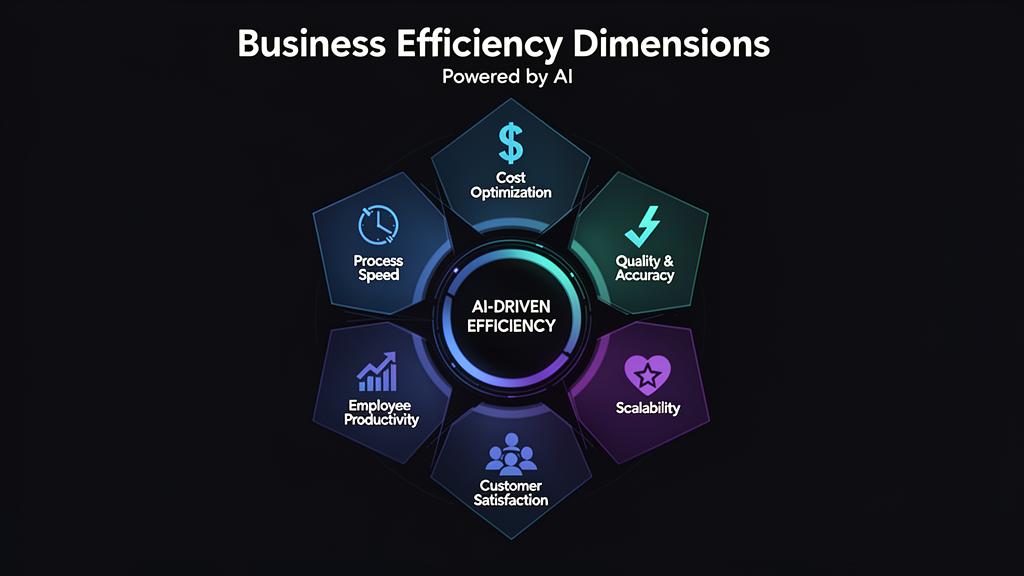
Cost Optimization: Beyond Simple Cost Cutting
AI-driven cost optimization goes far beyond traditional cost-cutting measures. Where legacy approaches often sacrifice quality or capability to reduce expenses, AI enables organizations to do more with less – reducing costs while simultaneously improving outcomes.
Intelligent resource allocation. AI algorithms analyze historical utilization data, demand patterns, and operational constraints to allocate resources – workforce, equipment, materials, energy – with precision impossible for human planners. A logistics company using AI-optimized routing can reduce fuel costs by 15–20% while improving delivery times. A manufacturing plant can reduce energy consumption by 10–15% through AI-controlled HVAC and production scheduling without impacting output.
Waste elimination. AI identifies waste across every operational dimension: overproduction, excess inventory, unnecessary motion, waiting times, defects, and over-processing. Machine learning models trained on production data can predict optimal batch sizes, material quantities, and process parameters – reducing waste by 20–40% in many manufacturing and service environments.
Procurement intelligence. AI analyzes spending patterns across the organization, identifies consolidation opportunities, predicts price fluctuations, and recommends optimal purchasing timing. Organizations deploying AI in procurement typically achieve 5–12% savings on addressable spend within the first year.
Predictive cost modeling. Rather than relying on historical budgets (which often perpetuate inefficiencies), AI builds dynamic cost models that factor in market conditions, operational performance, and strategic priorities. These models help leaders make investment decisions with far greater confidence and precision.
Process Speed: Accelerating Time-to-Value
In competitive markets, speed is often the decisive advantage. AI accelerates operational processes in ways that fundamentally change what's possible.
Intelligent process automation. AI-powered automation handles end-to-end processes in minutes that previously took hours or days. An insurance claim that once required 5–7 days of manual processing – document review, validation, assessment, approval – can be resolved in under an hour with AI handling document extraction, fraud scoring, policy validation, and routing. Only edge cases requiring human judgment reach a claims adjuster.
Real-time decision making. Traditional decision processes involve data gathering, analysis, committee reviews, and approval chains – often taking weeks. AI collapses this timeline by providing instant analysis, scenario modeling, and recommendations. A supply chain disruption that once triggered days of meetings and manual replanning can be addressed in minutes with AI-generated alternative sourcing plans, logistics rerouting, and customer communication strategies.
Parallel processing at scale. Human teams process tasks sequentially; AI processes thousands simultaneously. A bank that manually reviewed 500 loan applications per day can process 50,000 with AI pre-screening, scoring, and routing – with human reviewers handling only the complex cases. This isn't incremental improvement; it's an order-of-magnitude acceleration.
Cycle time compression. AI identifies and eliminates bottlenecks that slow processes. By analyzing process mining data, AI can pinpoint where delays occur, why they happen, and how to redesign workflows to eliminate them. Organizations typically see 30–60% cycle time reduction in processes where AI-driven optimization is applied.
Quality and Accuracy: Eliminating Error at Scale
Human error is the single largest source of operational inefficiency in most organizations. AI addresses this not by replacing humans, but by catching errors before they propagate and preventing the conditions that cause them.
Automated quality control. Computer vision and sensor-based AI systems inspect products, documents, and outputs with consistency impossible for human inspectors. In manufacturing, AI visual inspection catches defects with 99.5%+ accuracy, including subtle flaws invisible to the human eye. In financial services, AI validates transactions, reconciles accounts, and checks compliance with zero fatigue-related errors.
Predictive quality management. Rather than detecting defects after they occur, AI predicts quality issues before production even begins. By analyzing raw material properties, environmental conditions, machine settings, and historical quality data, AI models recommend optimal process parameters that maximize output quality. This "first-time-right" approach reduces rework, scrap, and customer complaints simultaneously.
Data quality and integrity. Poor data quality costs organizations an estimated 15–25% of revenue through incorrect decisions, failed processes, and missed opportunities. AI-powered data quality tools continuously monitor, cleanse, and enrich operational data – catching duplicates, correcting inconsistencies, filling gaps, and flagging anomalies. This clean data foundation amplifies the effectiveness of every other AI application.
Compliance accuracy. Regulatory compliance is an area where errors carry severe consequences – fines, reputational damage, license revocations. AI ensures consistent application of compliance rules across every transaction, document, and decision, reducing compliance violations by 70–90% compared to manual processes.
Scalability: Growing Without Proportional Complexity
Traditional operations face a fundamental scaling challenge: as volume grows, complexity and headcount grow proportionally (or faster). AI breaks this linear relationship, enabling organizations to scale dramatically without proportional increases in resources or complexity.
Elastic capacity. AI-powered processes scale up and down automatically based on demand. During peak periods, the same AI system that processes 1,000 transactions per hour can handle 100,000 without additional infrastructure or staffing. This elasticity is particularly valuable in industries with seasonal or unpredictable demand patterns.
Knowledge multiplication. When a human expert solves a complex problem, that knowledge stays in their head (and leaves when they do). When an AI system learns from a resolution, that knowledge is immediately available to every process, every agent, and every decision across the organization. This compounding effect means AI-powered operations get smarter and more capable with every interaction.
Geographic expansion. AI enables organizations to operate in new markets without replicating entire operational teams. Multilingual AI handles customer communications, local regulatory AI ensures compliance, and centralized AI-powered operations serve multiple geographies from a single hub. What once required a full local team can be achieved with AI plus a small local presence.
Complexity absorption. As product portfolios grow, regulations multiply, and customer expectations increase, operational complexity tends to overwhelm human teams. AI absorbs this complexity – managing thousands of SKUs, regulatory requirements, customer segments, and process variants – without the cognitive overload that degrades human performance.
Employee Productivity: Augmenting Human Capability
The most sustainable efficiency gains come not from replacing employees but from fundamentally augmenting what they can accomplish. AI serves as a cognitive multiplier, enabling each team member to deliver the impact of a much larger team.
Intelligent task routing. AI assigns tasks to the right person at the right time, considering skills, workload, urgency, and context. Instead of managers manually distributing work or employees picking from queues, AI optimizes the entire workflow – ensuring the most critical tasks reach the most qualified people, while routine items are handled automatically.
Knowledge access and decision support. AI puts organizational knowledge at every employee's fingertips. Instead of searching through documents, asking colleagues, or escalating to experts, employees get instant AI-powered answers, recommendations, and decision support. A new employee with AI support can perform at the level of a 5-year veteran within weeks, not years.
Administrative burden reduction. Knowledge workers typically spend 30–40% of their time on administrative tasks: filling out forms, updating systems, writing reports, scheduling meetings, searching for information. AI automates or eliminates most of this burden, freeing employees to focus on high-value work that requires human creativity, empathy, and judgment.
Continuous skill development. AI identifies skill gaps, recommends training, and provides real-time coaching during work. A customer service agent gets live suggestions during calls. A financial analyst receives AI-flagged anomalies that teach pattern recognition. This embedded learning accelerates professional development while improving operational outcomes.
Customer Satisfaction: The Ultimate Efficiency Metric
Operational efficiency means nothing if it doesn't translate to better customer outcomes. AI uniquely enables organizations to be simultaneously more efficient AND more customer-centric – resolving the traditional tension between cost optimization and service excellence.
Proactive service. AI detects potential customer issues before they materialize. A shipping delay is identified and the customer is notified with an updated delivery estimate and compensation offer before they even check their order status. An account anomaly is flagged and resolved before the customer notices. This proactive approach transforms customer perception from "they react when I complain" to "they're looking out for me."
Hyper-personalization at scale. Delivering personalized experiences to millions of customers was once economically unfeasible. AI makes it automatic – tailoring communications, recommendations, pricing, and service interactions to each customer's preferences, history, and context. Every customer feels like the most important customer, because to the AI, they are.
Consistent omnichannel experience. AI ensures that whether a customer interacts via phone, email, chat, mobile app, or in person, they receive consistent, context-aware service. The AI maintains a unified customer profile and conversation history across all channels, eliminating the frustrating experience of repeating information or receiving conflicting responses.
Speed of resolution. Faster processes directly translate to happier customers. When a claim is processed in hours instead of weeks, when a question is answered in seconds instead of being placed on hold, when a product is delivered a day early instead of a day late – these efficiency gains become customer satisfaction gains.
Predictive Maintenance: From Reactive to Proactive
AI models can predict equipment failures before they occur, enabling proactive maintenance that reduces downtime and extends asset lifecycles. This shift from reactive to predictive maintenance has saved organizations millions. By analyzing sensor data, historical failure patterns, environmental conditions, and usage patterns, AI can predict when a specific component will fail with remarkable accuracy – weeks or even months in advance.
The business impact is substantial: unplanned downtime costs manufacturers an estimated $50 billion annually. Organizations implementing AI-driven predictive maintenance typically see a 25–30% reduction in maintenance costs, a 70–75% decrease in equipment breakdowns, and a 35–45% reduction in downtime. Beyond cost savings, predictive maintenance improves safety by identifying potential failures before they create hazardous conditions.
Modern predictive maintenance systems go beyond simple threshold alerts. They use digital twin technology – AI-powered virtual replicas of physical assets – to simulate operating conditions, test maintenance scenarios, and optimize maintenance schedules. This approach balances the cost of maintenance interventions against the risk of failure, finding the optimal point that minimizes total lifecycle cost.
Supply Chain Intelligence
From demand forecasting to inventory optimization, AI is bringing unprecedented visibility and agility to supply chain operations. Real-time analytics enable rapid response to market changes and disruptions.
Demand sensing and forecasting. Traditional demand forecasting relied on historical sales data and seasonal patterns. AI-powered demand sensing incorporates hundreds of additional signals: weather forecasts, social media trends, economic indicators, competitor actions, event calendars, and even news sentiment. This multi-signal approach improves forecast accuracy by 30–50%, reducing both stockouts and excess inventory.
Autonomous inventory optimization. AI continuously balances inventory levels across the entire network – warehouses, distribution centers, retail locations, in-transit stock – considering demand forecasts, lead times, carrying costs, and service level targets. The result is lower total inventory (typically 20–30% reduction) with higher availability (95–99% fill rates).
Supply chain resilience. The COVID-19 pandemic exposed the fragility of global supply chains. AI now provides continuous risk monitoring – tracking geopolitical events, natural disasters, supplier financial health, and logistics disruptions – and generates contingency plans automatically. When a disruption occurs, AI can identify alternative suppliers, reroute shipments, and adjust production plans in hours rather than weeks.
End-to-end visibility. AI integrates data from suppliers, manufacturers, logistics providers, and customers into a unified real-time view of the entire supply chain. This visibility enables proactive management – identifying bottlenecks, predicting delays, and optimizing flow across the entire network rather than just within organizational boundaries.
The Transformation Journey: From Vision to Value
Deploying AI in operations is not a technology project – it's a business transformation. Organizations that treat it as "buying software" fail; those that approach it as a strategic capability-building exercise succeed. The transformation journey typically follows five phases:
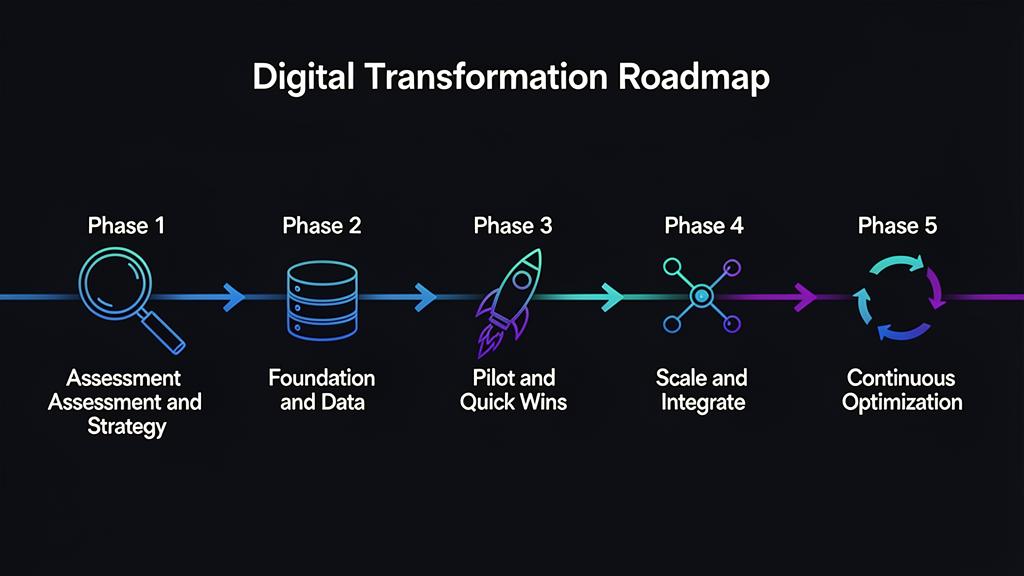
Phase 1: Assessment and Strategy
The transformation begins with a clear-eyed assessment of the current state and a compelling vision for the future. This phase involves:
Process mapping and pain point identification. Document current processes, quantify inefficiencies, and identify the highest-impact automation and AI opportunities. Use process mining tools to understand how work actually flows (not how it's documented) and where the biggest time and cost sinks exist.
Data readiness evaluation. AI is only as good as the data it runs on. Assess data quality, availability, accessibility, and governance. Identify gaps that need to be addressed before AI can be effective. Many transformation efforts stall because organizations underestimate the data preparation required.
Business case development. Quantify the expected value of AI deployment across efficiency dimensions: cost savings, speed improvements, quality gains, scalability benefits, and customer experience impact. Build a phased investment plan with clear milestones and ROI targets.
Organizational readiness. Assess culture, skills, and change management needs. AI transformation requires not just technical capabilities but also leadership commitment, employee engagement, and a willingness to redesign roles and processes.
Phase 2: Foundation and Data
Before deploying AI, organizations must build the foundational infrastructure:
Data platform. Establish a modern data architecture that integrates operational data from all sources – ERP, CRM, IoT sensors, documents, communications, external feeds. This doesn't mean a massive data warehouse project; modern approaches use data mesh and data lakehouse architectures that can be built incrementally.
Integration layer. Connect operational systems through APIs and integration platforms. AI needs to both read data from and write actions to operational systems. Without robust integration, AI remains an analytical curiosity rather than an operational tool.
Governance and ethics framework. Establish clear policies for AI decision-making: what can be automated, what requires human oversight, how biases will be monitored, and how transparency will be maintained. This framework prevents costly mistakes and builds trust with employees and customers.
Skills and roles. Begin building the team capabilities needed for AI operations: data engineering, AI/ML expertise, process design, and change management. This doesn't necessarily mean hiring armies of data scientists – platforms like Power Automate, AI Builder, and low-code tools enable business users to build and deploy many AI solutions.
Phase 3: Pilot and Quick Wins
Start with focused pilots that demonstrate value quickly and build organizational confidence:
Select high-impact, low-complexity use cases. Choose processes that are high-volume, repetitive, data-rich, and have clear success metrics. Invoice processing, customer inquiry routing, quality inspection, and demand forecasting are common starting points. Avoid starting with the most complex or politically sensitive process.
Deliver measurable results in 8–12 weeks. Quick wins build momentum and executive support. Aim for pilots that can show clear ROI within a quarter: "We reduced invoice processing time from 5 days to 4 hours" or "AI quality inspection caught 23% more defects than manual inspection."
Learn and adapt. Every pilot generates insights about data quality, integration challenges, change management needs, and AI model performance. Document these lessons rigorously – they're invaluable for scaling.
Phase 4: Scale and Integrate
With proven pilots and organizational buy-in, expand AI across operations:
Industrialize successful pilots. Move from proof-of-concept to production-grade deployments with proper monitoring, error handling, fallback procedures, and SLAs. What worked for 100 transactions per day must work reliably for 100,000.
Cross-functional integration. Connect AI-powered processes across departments. The real value of operational AI emerges when procurement AI talks to supply chain AI, which talks to production AI, which talks to customer service AI – creating an intelligent, self-optimizing value chain.
Center of Excellence. Establish a team that provides AI expertise, best practices, reusable components, and governance across the organization. This team accelerates deployment, ensures quality, and prevents duplication of effort.
Phase 5: Continuous Optimization
AI-powered operations are never "done" – they continuously learn and improve:
Performance monitoring. Track AI performance across all efficiency dimensions with automated dashboards. Monitor model accuracy, process speed, cost metrics, quality indicators, and customer satisfaction scores. Set alerts for degradation and triggers for retraining.
Feedback loops. Create mechanisms for human operators to provide feedback to AI systems. When an AI makes a wrong decision and a human corrects it, that correction should flow back into the model. This human-AI feedback loop drives continuous improvement.
Innovation pipeline. As AI capabilities mature and new technologies emerge (generative AI, multi-modal AI, agentic AI), continuously evaluate new opportunities. The foundation built in earlier phases makes each subsequent deployment faster and more impactful.
Culture of experimentation. Foster an organizational culture that encourages testing new AI applications, tolerates intelligent failure, and celebrates innovation. The organizations that win with AI are those that experiment fastest, learn most, and adapt quickest.
Operational Decision Support
AI-powered dashboards and recommendation engines provide operations leaders with actionable insights, enabling faster and more informed decision-making at every level of the organization.
Executive intelligence. C-suite leaders receive AI-curated briefings that highlight the most critical operational metrics, emerging risks, and strategic opportunities. Instead of reviewing 50-page reports, they interact with AI-powered summaries that surface what matters and allow drill-down into details on demand.
Operational command centers. AI-powered operations centers provide real-time visibility across the entire operational landscape – production status, supply chain flow, customer sentiment, financial performance, and workforce utilization – all in a single, integrated view. Anomalies are highlighted automatically, root causes are analyzed in real-time, and recommended actions are presented with expected outcomes.
Scenario planning and simulation. AI enables operations leaders to model "what-if" scenarios in minutes: What happens if demand increases 30%? What if a key supplier goes offline? What if we shift production from Plant A to Plant B? These simulations, powered by digital twin technology and predictive models, transform decision-making from gut-feel to evidence-based.
The Future of AI-Powered Operations
Looking ahead, AI in operations is evolving toward fully autonomous systems – operations that monitor, optimize, and even redesign themselves with minimal human intervention. Autonomous supply chains will sense demand shifts, adjust procurement and production, and reroute logistics in real-time. Self-healing IT infrastructure will detect and resolve issues before users are affected. AI-designed processes will be continuously tested, measured, and improved through automated experimentation.
But this future isn't about removing humans from operations – it's about elevating them. As AI handles the repetitive, analytical, and predictable aspects of operations, human operators become strategists, innovators, and relationship builders. The most successful organizations will be those that find the right balance: AI for scale, speed, and consistency; humans for creativity, empathy, and strategic judgment.
The transformation journey is demanding, but the prize is substantial. Organizations that commit to AI-powered operations are building a sustainable competitive advantage – one that compounds over time as AI systems learn, improve, and expand their capabilities. The question is no longer whether AI will transform operations, but whether your organization will lead that transformation or be disrupted by those who do.