
High-performance teams don't happen by accident. They are deliberately built through careful attention to culture, processes, and people. What changed my own leadership practice most, however, was not another management framework — it was the coaching approach taught in the ICC (International Coaching Community) holistic coaching methodology. It reframes the manager's role from "the person with the answers" to "the person who creates the conditions in which the team finds better answers than the manager could."
From Manager to Coaching Leader
Traditional management optimises for control: assign, monitor, correct. Coaching leadership optimises for awareness and ownership.
Two modes of leading — when to use which
Directive mode
- Crisis, safety, regulatory deadline
- Novice on an unfamiliar task
- Fast, explicit, low ambiguity
- Builds compliance
Coaching mode
- Development, complex trade-offs, change
- Competent people stuck in a pattern
- Slower up front, compounding returns
- Builds capability and commitment
The mistake most leaders make is not choosing the wrong mode — it is having only one. A high-performance team leader switches consciously and says out loud which hat they are wearing: "This one I'm deciding. This one I want you to own — let's think it through together."
Core Coaching Principles That Transfer to Team Leadership
Several ICC principles translate almost directly into everyday people management:
- Non-directiveness. Nothing is imposed. Solutions that people co-create are executed with an energy that assigned solutions never receive.
- Questions before answers. A question expands thinking; an instruction narrows it. Your default reflex as a leader should be curiosity, not correction.
- Respect for the person's values. People perform where their work touches what genuinely matters to them. Knowing your team members' values is operational knowledge, not soft trivia.
- Focus on goals, not problems. Problem talk produces explanations; goal talk produces movement. "What do we want instead?" is the pivot question.
- Clear responsibility split. The leader owns the quality of the process and the clarity of the frame. The team member owns direction, engagement, decisions and results.
- Ecology of change. Before pushing a goal, check its cost. If a target damages the person, the team, or the wider system, it must be redefined — the human is more important than the objective.
The Holistic View: You Lead Whole People
Holistic coaching treats a person as one coherent system — mind, emotions, body, beliefs, identity, values and life balance all influencing each other. There is no clean split between the "professional self" and the "private self"; the mind creates that division, reality does not.
For a manager this has a very practical consequence: performance problems are rarely competence problems. Before you build another training plan, check the layers underneath.
Levels to explore when performance drops
- Environment — tooling, workload, interruptions, remote/on-site setup
- Behaviour — habits, routines, how the work is actually organised
- Capabilities — skills, experience, access to knowledge
- Beliefs — "I can't push back on stakeholders", "asking questions makes me look weak"
- Values — is this work connected to anything the person cares about?
- Identity — "who am I in this team?"
Interventions applied at the wrong level fail predictably: a training course never fixes a limiting belief, and a motivational speech never fixes a broken process.
Psychological Safety First
The foundation of any high-performing team is psychological safety. When team members feel safe to take risks, voice opinions, and admit mistakes, innovation flourishes. Coaching gives you the concrete behaviours that create it:
- Listen at the deepest level. Not to reply, not to diagnose — to understand the person's map of the situation.
- Suspend judgement. Evaluation kills disclosure. Once people learn that honesty gets scored, they stop being honest.
- Contract explicitly. At the start of any 1:1 or team relationship, agree on boundaries, confidentiality and how feedback will be given. Clear norms protect trust better than good intentions.
- Model fallibility. Name your own mistakes and unknowns first. The team's tolerance for vulnerability never exceeds the leader's.
Clear Goals and Ownership
Every team member should understand not just what they're doing, but why it matters. Coaching adds rigour to how goals are set. A well-formed goal is stated positively (what we want, not what we want to avoid), is within the team's influence, has an observable evidence of success, and has been checked for side effects.
Six questions that turn a task into ownership
- What exactly do you want to achieve here?
- How will we both know it has succeeded?
- What is fully within your control, and what isn't?
- What could this change break elsewhere in the system?
- What resources or decisions do you need from me?
- What is your first step, and by when?
Systemic Thinking: The Team Is Not a Sum of Individuals
Nothing in a team exists in isolation. Every element influences every other element and the system as a whole — which is why the "difficult person" is often carrying a tension that belongs to the whole group, and why moving one talented engineer can change the dynamics of three squads.
- Before changing structure, map the real dependencies — including informal ones.
- When a conflict repeats, look for the systemic loop feeding it, not the guilty party.
- Consider each stakeholder system the team lives in: business owners, other tribes, vendors, regulators.
- Ask the ecology question routinely: "If we implement this, who else is affected and how?"
Continuous Feedback Loops
Annual reviews are relics of the past. High-performance teams thrive on continuous feedback — both giving and receiving. Coaching-style feedback is descriptive rather than evaluative, focused on a specific behaviour and its impact, and always ends with a forward-looking question that leaves ownership with the other person: "What would you do differently next time?"
Make the loop bidirectional. Regularly ask your team: what should I start, stop and continue doing as your leader? The answers are uncomfortable, and they are the fastest development path you have.
Coaching Conversations in the Manager's Calendar
- Weekly 1:1 (30 min). Their agenda, not yours. 80% questions, 20% input.
- Monthly development conversation. Values, growth direction, energy — not status.
- Quarterly goal review. Re-contract goals and check ecology as context shifts.
- Team retrospective. Facilitated, not led — the leader speaks last.
- Peer supervision for yourself. Leaders need a space to reflect too; that is what supervision groups exist for.
Celebrating Wins and Learning from Failures
Recognition fuels motivation, while thoughtful post-mortems turn failures into growth opportunities. The coaching frame makes both stronger: celebrate in the language of the team's values, and run post-mortems as awareness-building sessions rather than root-cause trials. The question is never "who broke it" but "what did this teach us about how our system behaves under pressure?"
High-Performance Teams in the Age of AI
Artificial Intelligence is changing the playing field for teams. Routine analysis, reporting, code generation, and pattern recognition are increasingly handled by AI assistants, which means the human contribution must shift to judgement, creativity, ethics, and collaboration. High-performance teams in the AI era are not teams that simply use more tools — they are teams that know how to co-create with intelligent systems while keeping human accountability at the centre.
What AI Changes — and What It Does Not
- Speed of execution. AI compresses research, drafting, data processing, and testing cycles. Tasks that once took days can be prototyped in hours.
- Decision support. Teams now have access to predictive models and scenario simulations, but the final call still requires human context, values, and risk appetite.
- Skill profiles. Deep technical expertise remains valuable, yet prompt engineering, critical evaluation of AI output, and interdisciplinary communication are becoming essential.
- Ethical responsibility. Bias, hallucinations, and data privacy risks require teams to question outputs rather than blindly adopt them.
- Relational work. Trust, negotiation, stakeholder alignment, and emotional intelligence are still irreplaceably human — and they become more important, not less, as technology accelerates.
The Manager's New Role: AI-Augmented Coaching
In an AI-augmented environment, the manager becomes a coach-curator: setting the strategic frame, selecting the right tools, teaching the team how to validate AI-generated insights, and protecting space for deep thinking. The coaching mindset is the natural fit here — instead of giving step-by-step answers, the manager helps the team ask better questions of both the data and of each other.
Five coaching questions for AI-era team decisions
- What problem are we actually solving — and for whom?
- What would a strong human judgement look like here, even if AI can generate options?
- How do we verify the quality and source of what the AI produced?
- Who is affected by this decision beyond our immediate team?
- What do we want to learn from this experiment, regardless of the outcome?
Teams that internalise these questions become learning systems: they move fast, but they also reflect fast. That combination — execution plus reflection — is what separates high-performance teams from merely busy ones in the age of AI.
Five Essential Conditions for High-Performance Teams in the Age of AI
As AI becomes embedded in daily work, high performance depends on five interlocking conditions. They are not separate initiatives; each reinforces the others. When all five are present, a team can move fast, learn faster, and keep human judgement at the centre.
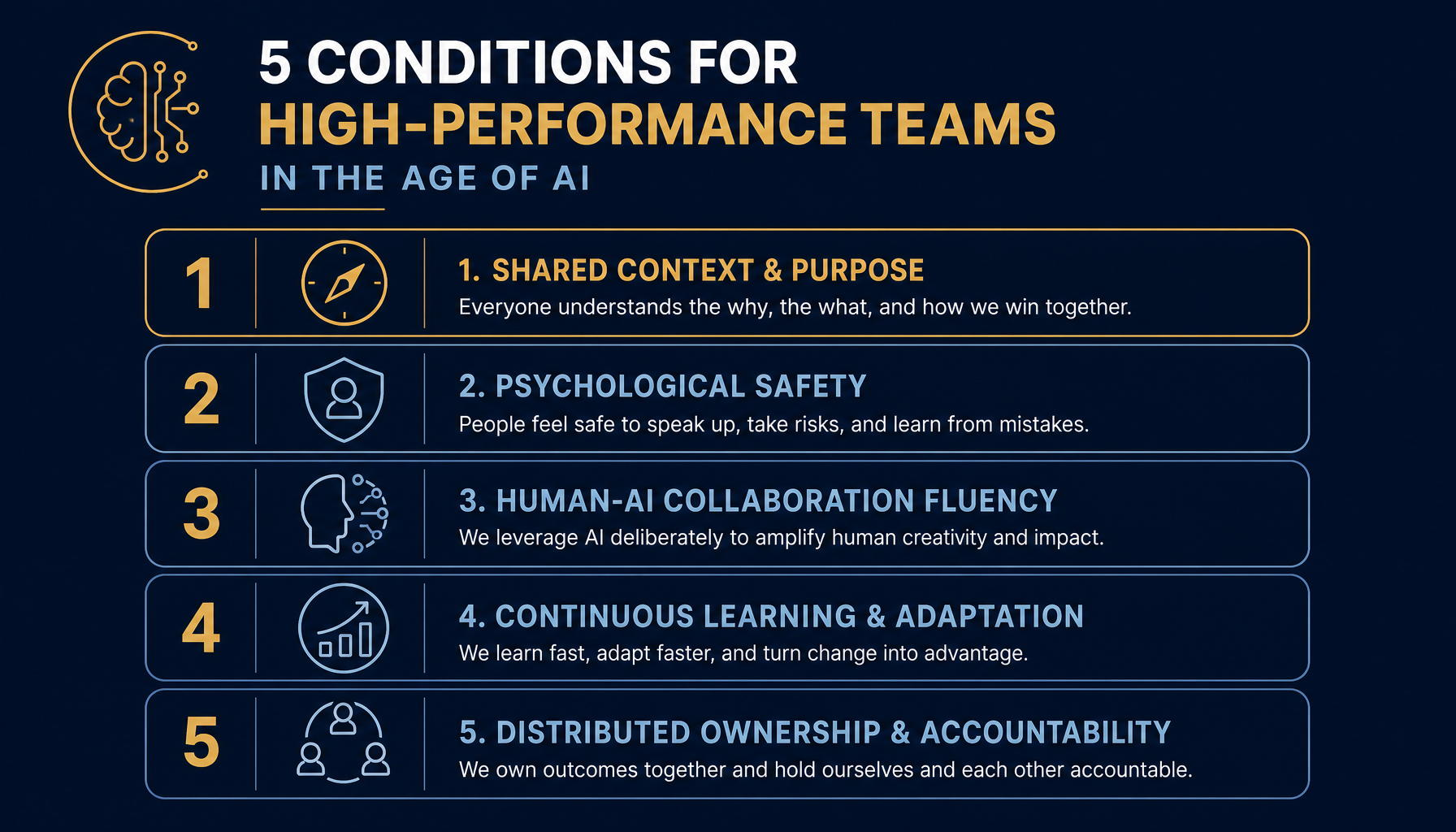
- Shared Context & Purpose. Everyone understands the why, the what, and how the team wins together. In an AI-augmented environment this means agreeing not only on business goals, but on where human judgement is non-negotiable and where AI assistance is welcome.
- Psychological Safety. People must feel safe to challenge AI outputs, admit mistakes, and ask naive questions. Without safety, teams will quietly accept algorithmic recommendations rather than stress-test them.
- Human-AI Collaboration Fluency. High-performance teams do not delegate thinking to tools. They learn to prompt critically, validate outputs, and combine machine speed with human sense-making.
- Continuous Learning & Adaptation. Models, markets, and customer expectations change constantly. The team treats every iteration as feedback, runs frequent retrospectives, and updates its playbooks rather than relying on static processes.
- Distributed Ownership & Accountability. Ownership is not held by the manager alone. Decisions, quality, and outcomes are shared — with clear accountability for both human choices and the way AI is used.
These five conditions are the practical architecture behind the coaching mindset. They turn abstract ideas like trust and agility into observable team behaviours. A manager who builds them deliberately is not only leading a high-performance team; they are designing a team that can keep performing as AI continues to evolve.
Common Traps for Coaching Leaders
- Fake coaching. Asking leading questions that smuggle in your answer. People see it immediately, and it costs trust.
- Coaching everything. Some situations need a decision, not a dialogue.
- Blurred roles. You are the manager — you evaluate and you decide on pay and promotion. Be transparent about that boundary; for deep personal work, external coaching is the honest answer.
- Rescuing. Solving problems for people feels helpful and quietly removes their ownership.
- Over-relying on AI. Delegating thinking to algorithms weakens the team's judgement muscle. Use AI as a sparring partner, not a replacement for reflection.
What Changes When You Lead This Way
Teams led with a coaching approach make more decisions without escalation, surface bad news earlier, and adapt faster because their thinking capacity — not just the leader's — is engaged. The leader's job shifts from producing answers to producing clarity, safety, and space for the team to grow into.
Conclusion: Why the Coaching Process Matters
Understanding the coaching process — as taught by ICC and applied in everyday management — is not a nice-to-have for modern leaders. It is a structural advantage. In a world where AI handles more of the routine, the manager's differentiator is the ability to unlock human potential: awareness, ownership, creativity, and trust.
The five conditions for high-performance teams in the age of AI — shared context, psychological safety, human-AI fluency, continuous learning, and distributed ownership — are not accidental. They are built through the daily practice of coaching leadership: asking better questions, creating safety, clarifying purpose, and sharing accountability.
Coaching methods give managers a disciplined way to do exactly that. They replace command with curiosity, diagnosis with dialogue, and control with co-created responsibility. They help the leader see the whole person, the whole system, and the real goal behind the stated problem.
High performance, in the end, is a by-product. Build whole people, in a system that supports them, around goals they genuinely own — and results follow. In the age of AI, that human-centred discipline is what will separate teams that merely survive from teams that consistently lead.