Article originally published in Polish. An English summary is available at the end of the article.
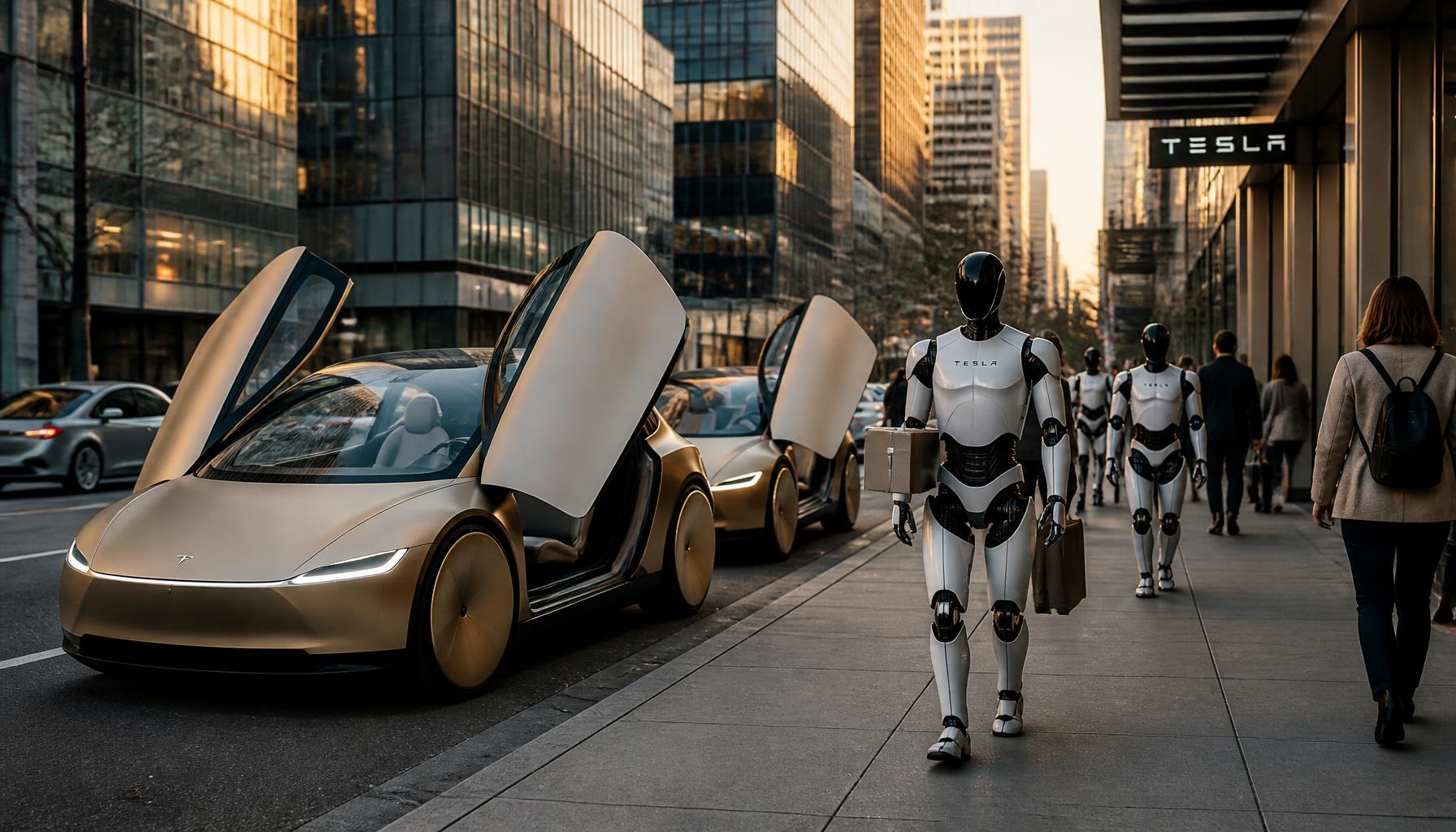
September 2026 will likely be a date we cite in presentations for the next decade. Within eight months, Tesla did two things that not long ago would have sounded like slides from a visionary conference: it shut down production of two of its flagship cars in order to build humanoid robots on their line, and it launched a commercial fleet of steering-wheel-free vehicles in Austin whose fares genuinely compete with Uber.
From the perspective of someone who has spent two decades on digital transformation in financial services, this is not a story about cars or robots. It is a story about cost structure — and cost structure is the one thing that truly changes markets.
1. Austin: a ride at half the price
On September 3, 2026, Tesla unveiled the Cybercab in downtown Austin, and the following day — at 5:00 p.m. local time — opened ride bookings to all city residents. It was the first moment anyone could order a mass-produced vehicle with no steering wheel and no safety driver (Not a Tesla App, September 4, 2026). The Cybercab was priced lower than the earlier Model Y-based robotaxi rides — Tesla deliberately positioned the new vehicle as a cheaper tier.
Reporters from the Austin American-Statesman rode the same route by Cybercab, Uber and Waymo on launch day, comparing receipts side by side (Statesman, September 4, 2026). The Tesla community had run similar comparisons earlier in September: four unsupervised robotaxi rides covering roughly 8 miles cost significantly less than equivalent Uber trips (Basenor, September 2, 2026).
It is worth looking at the numbers rather than the headlines. In June 2026 the Austin robotaxi price list stood at a USD 3.00 base fare plus USD 1.40 per mile, which came to about USD 10 for a five-mile ride; the target operating cost declared by Elon Musk is USD 0.20 per mile — seven times less than today's price (Tesorb, June 24, 2026).
Three price-per-mile tiers — and what separates them
- Uber / classic ride-hailing — the fare embeds the driver's time and income, which make up the bulk of the ride's cost.
- Robotaxi today (~USD 1.40/mile + base fare) — no driver, but there is remote supervision, a small fleet, and high depreciation on a vehicle adapted for the task.
- Tesla's target (~USD 0.20/mile) — a vehicle designed exclusively for autonomous driving, with no steering wheel or pedals, high daily utilization, and production scale measured in the hundreds of thousands of units.
The gap between the first and third tier is not a promotion. It is the removal of the most expensive line item — human labor — from the equation, replaced by capital that gets cheaper every year. We observed exactly the same mechanism in banking: the cost of serving a customer in a branch never fell by half, while the cost of the same operation in an app fell by an order of magnitude. Automation does not optimize the old process — it replaces it with a different process that has a different cost curve.
A methodological caveat worth keeping in mind: current robotaxi prices include an element of subsidy. Tesla is building market share and data, not margin. A fair comparison with Uber will only be possible once the fleet exceeds tens of thousands of vehicles and the service expands beyond the climate-friendly cities of Texas and Florida.
2. Fremont: the end of the Model S and X
On January 28, 2026, during the Q4 earnings call, Elon Musk announced the end of Model S and Model X production and the conversion of the Fremont factory line into a production line for Optimus humanoid robots (CNBC, January 28, 2026). The decision was confirmed by other outlets, which described it as a deliberate pivot by Tesla from automotive to robotics (The Guardian, January 28, 2026) (USA TODAY, January 28, 2026).
The last Model S rolled off the line on May 9, 2026, and dismantling the line itself began the following day, taking 46 days (Tesorb, June 15, 2026). On the Q1 earnings call Musk announced that Optimus production at Fremont would start around late July/August, while warning that the initial volume would be "very slow" (Electrek, April 22, 2026).
The scale of the stated ambitions is what makes the biggest impression — and draws the greatest skepticism. Tesla talks about 1 million Optimus units per year at Fremont and 10 million per year at Giga Texas. For comparison: total global shipments of industrial robots in 2024 amounted to 542,000 units (Tesorb, July 22, 2026). In other words, Tesla is claiming a production capacity equivalent to roughly twenty times today's entire global robot market.
2026 timeline
- January 28 — decision to wind down the Model S and X, announced with Q4 2025 results.
- March 12 — Musk reports that Optimus 3 is in its final development stage and production could start in summer (Teslarati, March 12, 2026).
- April 22 — Q1: start of Optimus production announced for late July/August.
- May 9 — the last Model S leaves Fremont; dismantling of the line begins the next day.
- July 22 — Q2: first photos of the converted line, no volume disclosed.
- September 3–4 — Cybercab launch and public opening of rides in Austin.
One thing worth noting, easy to overlook: closing the Model S and X is not a cost cut — it is capital allocation. Tesla gave up symbolic products — the cars that built the brand — because it calculated that the same factory floor, the same process engineers and the same supply chain would generate a higher return by building robots instead. This is a portfolio decision in its purest form, and exactly the kind of call that never gets made at most corporations — because the emotional cost of shutting down a flagship product outweighs board-level courage.
3. Robots that build robots
The most interesting piece of this puzzle is not in Austin or in the boardroom. It is on the factory floor. Tesla has consistently said that Optimus's first customer is Tesla itself — the robots are meant to work in its factories, performing tasks that are repetitive, ergonomically punishing, and hard to staff.
This creates a loop worth naming explicitly:
The self-reinforcing loop
- Step 1 — humans build the first generation of robots.
- Step 2 — robots go on the line and take over part of car assembly.
- Step 3 — robots start participating in the manufacturing of further robots, lowering the unit production cost.
- Step 4 — a lower unit cost allows for higher volume, and higher volume generates more training data.
- Step 5 — more data means a more capable robot able to handle a wider range of tasks. Back to step 2.
In economic theory we would call this a decreasing marginal cost of physical labor. In practice, it means industrial production could start behaving like software: a high cost for the first unit, a radically low cost for every subsequent one. If this loop truly closes, the consequences will extend far beyond Tesla — because the model of "a production line staffed by robots building robots" is replicable by anyone with capital and access to components.
In fairness, it's worth noting where this narrative could stall. First, manual dexterity: grip, force control and operating in unstructured environments remain the hardest problem in robotics, and raw compute power alone doesn't solve it. Second, the supply chain for actuators and permanent magnets, which is a geopolitical bottleneck. Third, cycle time and reliability — a robot that is 20% slower than a human but works 22 hours a day pays off; a robot that stops the line once a shift never does.
4. Dual-use technology: the same tech stack, two markets
To understand where this loop is heading, we need a concept that is canon in the defense industry but still a surprise in public debate: dual-use technology. Under EU export control law, these are products "which can be used for both civil and military purposes" (EU Regulation 2021/821). What is surprising is not that such a category exists — it's how narrow the line between civilian and military has become today.
Let's break Tesla's tech stack into pieces and label its counterpart on the other side:
Tesla's stack and its military counterpart
- Lidar-free visual perception — a system that "sees" the streets of Austin through cameras can identify objects in the field without illumination, GPS or connectivity. This is a critical dependency: navigation solutions based on LIDAR are easily jammed, while purely optical vision is much harder to disrupt.
- Edge decision-making autonomy — an onboard computer trained on billions of miles of driving is the same class of system needed by an unmanned ground vehicle (UGV) handling last-mile resupply at the front.
- Motors and power electronics — experience in cheap, mass-produced electric drivetrains and energy storage translates directly into powering field bases and driving unmanned platforms.
- Optimus's dexterity — a manipulator capable of assembly-line work is a manipulator capable of handling hazardous materials, mine clearance or ammunition logistics — without putting people at risk.
- Mass production — the ability to build a million complex devices a year is not merely a commercial asset in wartime conditions, but a strategic one. Historically, wars have been won by production capacity, not by the perfection of a single design.
This is not theoretical speculation — we are already observing the reverse direction of the same flow. The war in Ukraine showed that civilian consumer drones, FPV solutions and satellite networks designed for the consumer market became decisive battlefield systems (RUSI, 2023). Meanwhile, the American company Anduril built its entire business model on inverting the traditional defense logic: instead of designing weapons from scratch, it buys mature civilian technologies and adds a military layer — sensors, AI, cheap autonomy — producing systems at a fraction of the cost of traditional platforms (Anduril, "Rebooting the Arsenal of Democracy," 2022). Tesla is entering this game with its most valuable asset: not a design, but a production line.
It's worth adding one ethical caveat that is more relevant here than anywhere else. Dual use means that the engineer optimizing a robot's grip for dashboard assembly does not need to know that the same algorithm is handling a warhead. The line does not run between separate labs — it runs inside a single codebase. This requires boards not only to maintain export controls, but to have an explicit dual-use policy that defines where the company draws the line before crossing it becomes commercially convenient.
5. Defense manufacturing: the natural next step
If we accept that robots can build robots, the most predictable place to deploy this loop outside of automotive is the defense industry. The reason is prosaic and has little to do with science fiction: this is a sector where demand can spike suddenly, volumes shift month to month, and the scaling barrier is not technology but the lack of skilled hands and the time needed to train them.
The war in Ukraine demonstrated that advantage is decided by the pace of loitering munition and drone production — relatively simple products manufactured in the millions, with short design life cycles. This is the ideal profile for automated, reconfigurable lines: a line staffed by humanoid robots doesn't need mechanical retooling when the product variant changes, just a software update and a new set of grippers.
Why defense manufacturing will follow this path
- Volume flexibility — the ability to multiply output several times over without recruiting and training thousands of workers.
- Operational continuity — three-shift work with no ergonomic limits and no staff turnover.
- Process safety — operations involving explosives and chemicals carried out without endangering people.
- Production sovereignty — the ability to manufacture domestically without depending on an external labor supply.
- Short design cycles — a new drone version every few weeks requires a line that gets reprogrammed, not rebuilt.
Let me be explicit: this is my directional forecast, not an announcement by any specific company. Tesla has not communicated any plans for defense manufacturing. The economic logic, however, is unambiguous, and Europe's programs to rebuild defense industrial capacity are entering this decade with exactly the problem that humanoids address best: a lack of workers and the need to rapidly scale volume.
This raises a question that cannot be settled by a cost calculation. Autonomous production of weapons systems requires very strict oversight frameworks — from export controls, through supply chain traceability, to the principle that the decision to use force remains with a human. The technology will be ready before the regulations are. It has always been that way.
6. What this means for financial services
One might ask why an executive from the financial industry is writing about robots. The answer is simple: each of these shifts will hit a bank's, a lessor's and an insurer's balance sheet before it hits the street.
Five consequences for the financial sector
- Residual value — leasing models assume a predictable car value after 3–5 years. An autonomous fleet driving 100,000 kilometers a year has a completely different depreciation curve than a private car doing 15,000.
- The object of financing — today we finance a vehicle. Tomorrow we will finance production capacity: a fleet of robots with a given hourly output. That is a completely different risk analysis and a different form of collateral.
- Insurance — liability shifts from the driver to the software producer. The entire actuarial base of motor insurance is built on the behavior of a human behind the wheel.
- Corporate client cost structure — if production stops being labor-intensive, the credit risk profile of entire industries changes. Sector analysis built on labor costs stops working.
- Revenue models — billing per ride, per hour of robot work, per task completed. These are high-frequency, low-unit-value payments — machine-to-machine payment infrastructure.
A financial institution that treats this as a technological curiosity will wake up with a portfolio priced on assumptions that no longer hold. An institution that starts building competence in valuing autonomous assets now will have a three-year lead.
7. How to read this data without hype or cynicism
Tesla's track record demands interpretive discipline. Announced timelines at this company routinely slip — the Optimus V3 launch itself was pushed back several times in 2026 (Electrek, April 22, 2026), and despite confirming the line conversion, Tesla had not disclosed any concrete robot production volume as of July 2026 (RoboZaps, 2026).
I propose a simple heuristic that I apply to all early-stage technologies:
Three questions instead of a forecast
- What already works and can be paid for? In Austin you can order a ride today and see the receipt. That is a fact, not a promise.
- What has been physically built? The dismantled Model S line is an irreversible capital investment, not a slide.
- What remains only a declaration? Ten million robots a year and USD 0.20 per mile are, as of today, targets, not results.
Separating these three categories is the most important managerial skill of this decade. It's not about predicting exactly when a humanoid robot will walk into a Polish factory. It's about recognizing the direction early enough to prepare the organization — competencies, valuation models, data architecture.
Summary
Within a single year, Tesla turned a car factory into a robot factory and put a vehicle on city streets that carries people more cheaply than a driver would. Both decisions stem from the same thesis: physical labor is ceasing to be the economy's most expensive and least scalable resource.
If this thesis proves even half true, it will change not just the automotive industry. It will change how we value assets, finance enterprises and build teams. And because nearly every element of this stack is dual-use in nature, it will also change how we plan defense capabilities — from autonomous logistics to the mass production of unmanned systems. My advice to leaders has stayed the same for years, and it applies here too: don't try to predict the date. Build an organization that can change its mind faster than the competition.
English summary
In January 2026 Tesla announced the end of Model S and X production and the conversion of its Fremont lines to Optimus humanoid robot manufacturing; the last Model S left the line on 9 May 2026. In September 2026 the purpose-built Cybercab opened to the public in Austin at fares materially below comparable Uber rides, against a long-term operating cost target of USD 0.20 per mile. This article examines the resulting cost curve, the self-reinforcing loop of robots manufacturing robots, the dual-use nature of Tesla's technology stack — vision-based autonomy, edge compute, electric drivetrains and mass manufacturing — and its likely extension into defence manufacturing of robots and drones, plus what all of it means for asset valuation, leasing residuals, insurance and credit risk in financial services.