The landscape of digital product management is evolving at an unprecedented pace. Digital product leaders are no longer focused solely on delivering isolated features. They are responsible for designing seamless, intelligent, and deeply contextual customer experiences across multiple channels, devices, and ecosystems.
In the financial services and leasing industry, this transformation is especially visible. Customers expect the same service to be accessible through a mobile app, a customer portal, conversational interfaces, and increasingly through connected environments such as Android Auto, Apple CarPlay, and in-vehicle digital services. Product management is shifting from feature delivery to experience orchestration.
AI-Powered Product Development
AI is becoming a foundational layer of product management itself—transforming how digital products are discovered, designed, tested, launched, and optimized. Product teams use AI to analyze customer feedback, detect friction points, generate hypotheses, and recommend feature prioritization based on behavioral and commercial data.
In a leasing company, AI-powered product development creates value across every major product line:
- Leasing: AI identifies drop-off moments in applications, suggests optimal financing configurations for passenger cars, fleets, or machinery based on customer profiles and conversion rates.
- Rental / Long-Term Hire: Predictive personalization recommends vehicle classes, mileage packages, service bundles, and detects early churn indicators.
- Leasing Loan: AI streamlines eligibility, proposes alternative financing structures, and creates dynamic offers tailored to asset type and payment behavior.
- Consumer Rental: Simplified mobile-first experience built around monthly affordability, with AI driving personalized onboarding and next-best-offer.
AI also improves internal operations—generating user stories, summarizing workshops, forecasting feature adoption, and identifying risks before launch. The key cultural shift: teams must stop treating AI as an add-on and start embedding it into the product operating model.
The Rise of Product-Led Growth
More organizations are embracing product-led growth, where the product itself becomes the primary engine of acquisition, conversion, and retention. In digital leasing, this is a profound shift from traditional sales-dependent distribution.
A product-led growth approach requires several mindset changes:
- From process to value orientation: Instead of digitalizing existing processes, focus on helping customers achieve goals in the simplest, most trustworthy way.
- From products to needs: Customers think in terms of acquiring a car, equipping a company, or replacing laptops—not "leasing" vs "leasing loan."
- From channel-specific to unified journeys: A user may start in a marketplace, continue in an app, upload documents in a portal, and manage contracts via a connected car interface.
- From one-time acquisition to lifecycle growth: Contract management, upgrades, renewals, cross-sell, insurance, maintenance, and remarketing.
Data-Driven Decision Making
The value of data lies not in dashboards alone, but in turning data into decisions, experiments, and measurable outcomes. Modern product teams combine behavioral analytics, commercial performance, and customer feedback into one product intelligence layer.
In leasing, data-driven management should cover the full lifecycle:
- Acquisition: Which campaigns and product variants convert best? Where do digital journeys see abandonment?
- Onboarding: Which documents cause delay? Which channels produce highest completion rates?
- Usage: Which self-service features drive engagement? What prompts work—push, in-app, email, WhatsApp, or voice?
- Retention: Which behaviors indicate renewal intent or attrition risk? What bundles improve retention?
- Cross-sell: Insurance, service packages, charging solutions, telematics, equipment upgrades, remarketing, or refinancing—at the right time.
The Omnichannel Future: Where Digital Products Will Live
The biggest strategic question is no longer "What features should we build?" but "In which channels should the product exist?" The answer: everywhere the customer already is.
1. Mobile Applications
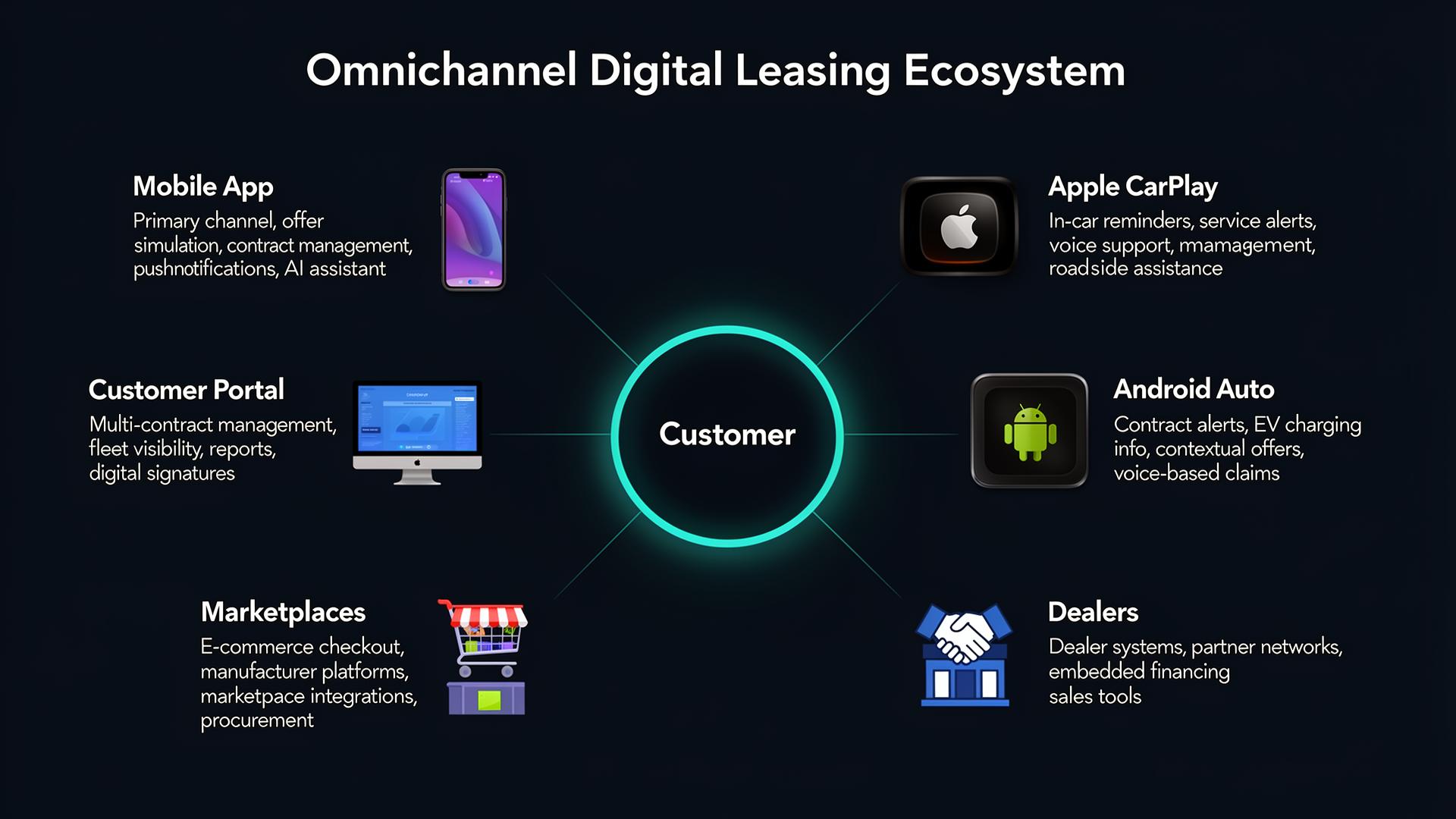
The mobile app is the most personal and active digital channel in the leasing ecosystem. It serves as the primary interface for retail and SME customers, offering a rich, always-available experience that covers the entire lifecycle:
- Offer simulation and product comparison with real-time pricing
- Contract overview, payment schedules, and outstanding balance tracking
- Document upload, digital signature, and identity verification
- Push notifications for payments, milestones, renewals, and service reminders
- AI-powered virtual assistant for questions, claims, and support requests
- Service booking, roadside assistance, and incident reporting
- Cross-sell and upsell surfaces: insurance, service packages, charging solutions
For many users, the mobile app becomes the primary operating system for their entire financial relationship with the leasing provider.
2. Customer Portal
The web-based customer portal is essential for business and corporate clients who require structured, multi-contract management capabilities. Unlike the mobile app, the portal excels in complex, detail-rich interactions:
- Fleet-level visibility across all contracts, assets, and cost centers
- Multi-user account management with roles and permissions
- Downloadable reports: invoices, payment history, asset depreciation, tax documentation
- Digital signatures and contract amendments
- Service history and maintenance scheduling for all leased assets
- Embedded advisor communication via secure chat or video call
- Self-service tools for early termination, buyout simulation, or contract extension
For corporate clients, the portal evolves into a full control center—bridging finance, operations, and fleet management in a single digital workspace.
3. Marketplaces
Marketplaces represent the most powerful embedded distribution channel for leasing. By integrating directly into platforms where customers already browse and compare vehicles or equipment, leasing becomes part of the purchase decision—not an afterthought:
- Real-time financing offers embedded in vehicle or equipment listings
- Pre-qualification and instant decisioning within the marketplace checkout
- API-driven product configuration: rates, terms, residual values, and bundles
- Seamless handoff from marketplace to leasing onboarding with pre-filled data
- Co-branded experiences that maintain trust across the customer journey
- Analytics and conversion tracking shared between marketplace and lessor
Marketplace integration shifts leasing from a back-office process to a point-of-sale experience, dramatically increasing reach and conversion rates.
4. Apple CarPlay
Apple CarPlay opens a unique, contextual channel directly inside the vehicle. For car leasing, this creates touchpoints that were previously impossible—engaging the customer exactly when and where the leased asset is being used:
- Proactive reminders about upcoming inspections, tire changes, or contract milestones
- Voice-activated support for roadside assistance or incident reporting
- Contextual alerts: insurance renewal, service appointments, or lease expiry countdowns
- One-tap access to nearest service centers, charging stations (for EVs), or partner locations
- Smart notifications about upgrade opportunities, buyout options, or renewal deals
CarPlay transforms the in-car experience into a natural extension of the leasing relationship, connecting seamlessly with the mobile app and customer portal.
5. Android Auto
Android Auto mirrors the in-car engagement capabilities of CarPlay, extending the leasing ecosystem to the dominant mobile platform. With Android's broader device and vehicle compatibility, it widens the reach of contextual, vehicle-based interactions:
- Real-time notifications about leasing milestones, payments, or maintenance due dates
- Voice-driven commands for claim filing, support requests, or appointment scheduling
- Integration with Google Maps for service center navigation and EV charging routing
- Contextual offers based on driving patterns, mileage, or contract utilization
- Seamless data sync with the mobile app for a unified cross-device experience
Together with CarPlay, Android Auto ensures that every lessee—regardless of their device ecosystem—has access to low-friction, in-car engagement with their leasing provider.
6. Dealers
Dealers remain a critical channel in the leasing value chain, but their role is being fundamentally reshaped by digital tools. The modern dealer channel is no longer just a physical point of sale—it's a digitally enabled partner ecosystem:
- Digital dealer portals for real-time offer calculation, credit checks, and contract generation
- Tablet-based tools for in-showroom customer onboarding with e-signature and ID verification
- API-driven integration between dealer management systems (DMS) and the lessor's platform
- Automated document workflows reducing manual processing and handover delays
- Co-browsing and video support connecting dealer sales staff with leasing specialists
- Performance dashboards for dealers: conversion rates, pipeline, and commission tracking
By equipping dealers with digital-first tools, leasing companies accelerate time-to-contract, improve data quality, and create a consistent customer experience across both digital and physical channels.
Customer Journey as the Core of Product Design
The most successful digital products in leasing are designed around customer journeys, not internal organizational structures or legacy product silos.
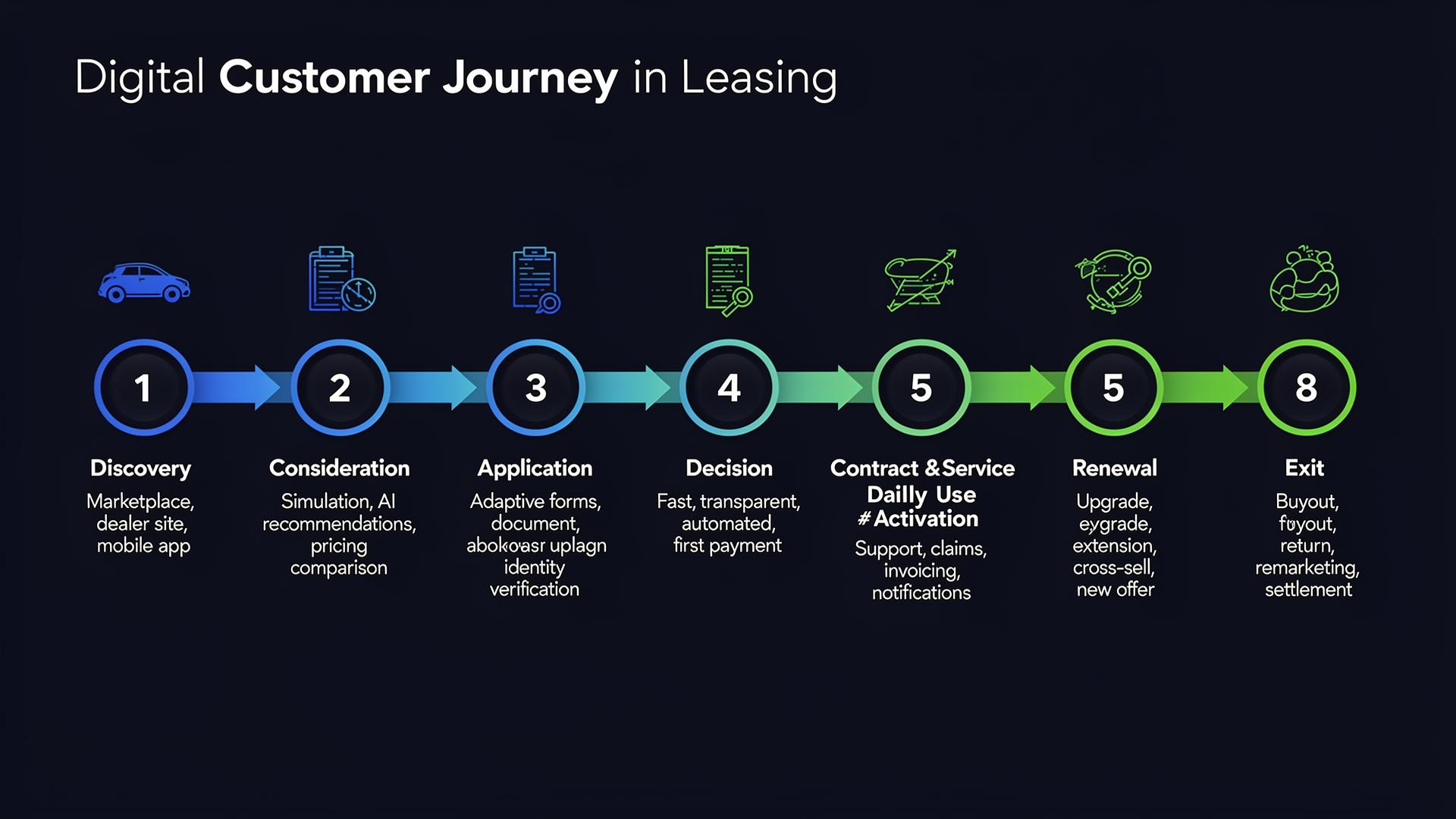
Eight key journey stages define the modern digital experience:
- Discovery: The customer becomes aware of a need—browsing marketplaces, visiting dealer websites, exploring mobile apps, or responding to targeted campaigns. Digital product teams must ensure visibility, relevance, and seamless entry points across all acquisition channels.
- Consideration: The customer actively compares options—running offer simulations, reviewing terms, and evaluating total cost of ownership. AI-powered recommendations, transparent pricing, and intuitive comparison tools are critical to winning at this stage.
- Collaboration: A distinctive stage where the customer engages directly with the leasing provider through conversational interfaces—chatbots, voicebots, secure messaging, or video consultations. This is where questions are answered, objections are handled, and trust is built through real-time, personalized interaction.
- Application: The customer submits a financing request. Best-in-class experiences are adaptive, short, and context-aware—pre-filling data from previous interactions, minimizing document requirements, and guiding users through each step with clear progress indicators.
- Decision: The leasing provider evaluates and responds. Speed, transparency, and communication are paramount. Automated credit decisioning with real-time status updates, clear explanations of outcomes, and immediate next-step guidance define excellence here.
- Contract & Activation: Digital signature, contract generation, handover coordination, and first payment setup. This stage must feel seamless—eliminating paper, reducing wait times, and providing immediate confirmation and access to the customer portal or mobile app.
- Daily Use & Service: The longest and most impactful stage. Customer satisfaction is won or lost here through self-service capabilities, proactive notifications, claims handling, invoice management, maintenance scheduling, and responsive support across all channels.
- Renewal: Proactively engaging customers before contract expiry with personalized renewal offers, upgrade proposals, buyout simulations, or fleet optimization recommendations. Data-driven timing and relevance are key to maximizing retention.
- Exit: Managing contract termination with clarity and professionalism—vehicle return coordination, final settlement processing, deposit refunds, and feedback collection. A well-handled exit preserves the relationship for future business and referrals.
Product Strategy by Asset Group
Different asset categories require fundamentally different digital approaches:
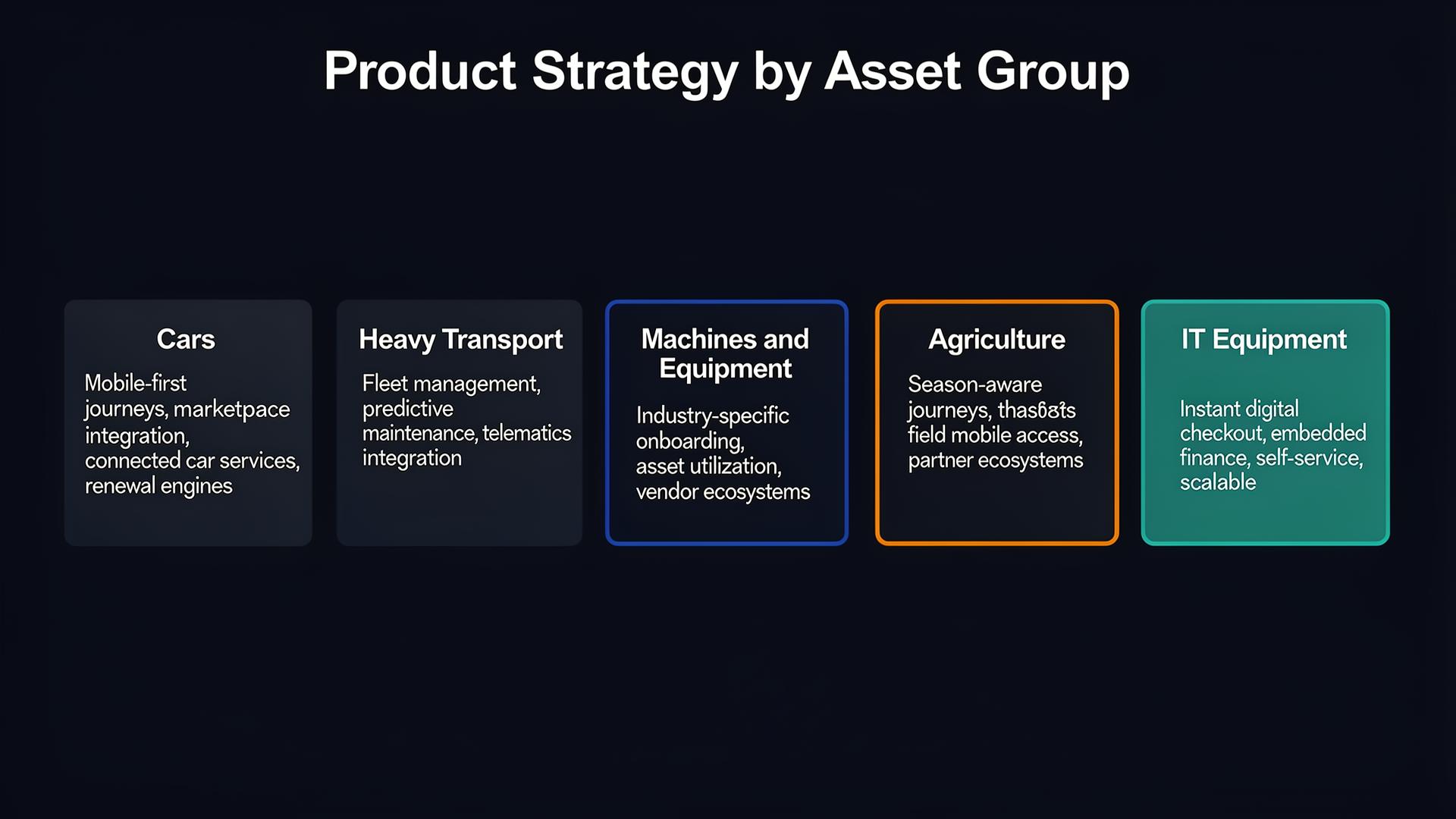
- Cars: Most digitally mature. Strong opportunity for mobile-first journeys, marketplace integration, connected car services via Android Auto / Apple CarPlay, and renewal engines.
- Heavy Transport: Fleet-level digital management, predictive maintenance, telematics integration, downtime-sensitive support, high-value relationship management.
- Machines & Equipment: Industry-specific onboarding, service workflows, asset utilization visibility, vendor and servicing ecosystem integration.
- Agriculture: Season-aware journeys, simplified field access via mobile, document-light flows, partner ecosystems aligned with agricultural rhythms.
- Small IT & Computers: Ideal for highly digital, embedded, almost instant financing and rental journeys—scalable via digital checkout and self-service.
Looking Ahead
The leasing industry stands at an inflection point. The companies that will define the next decade are not those with the largest portfolios or the lowest rates—they are those that master the art of digital product orchestration. This means building products that live across channels, adapt to customer context in real time, and leverage data and AI not as buzzwords, but as core operating principles.
The role of the digital product manager is evolving from a feature owner into an ecosystem architect—someone who connects customer journeys, technology platforms, data intelligence, partner networks, and business strategy into a coherent, differentiated experience. This requires a rare combination of technical depth, commercial instinct, and relentless customer empathy.
The shift is already underway. Marketplaces are becoming primary acquisition channels. In-car platforms are creating entirely new engagement surfaces. AI is moving from back-office automation to front-line customer interaction. And customers—both retail and corporate—expect seamless, intelligent, omnichannel experiences as the baseline, not the exception.
Organizations that treat digital product management as a strategic capability—investing in talent, technology, and cross-functional alignment—will build compounding competitive advantages. Those that don't will find themselves competing on price alone in an increasingly commoditized market.
The next era of leasing belongs to those who don't just digitalize products, but reimagine them.